|
|
|
|
 |
|
 |
|
|
News
Order a Brochure
New Activity
Free Guided Walks in the Peak
District
Accommodation
New Attraction
Lea Nr Matlock Bath
Residential Art Courses in Painting, Sculpture and Drawing
New Website

|
|
Blue JohnBlue John
is a rare mineral found at only one location in the world. The name Blue John derives from the French Bleu
Jaune meaning Blue Yellow.
It is a form of
fluor spar and was discovered as miners were exploring the cave systems of Castleton
for lead.
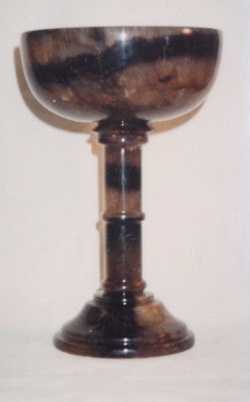
Nowadays, the caves of Castleton are magnificent show caves and are some of the most popular tourist attractions in Derbyshire. Of the four show caves only Treak Cliff and, to a lesser extent, Blue John have veins of Blue John. Treak Cliff Cavern still mines about 500 kilograms of Blue John each year. The veins of Blue John are easy to see and many of the formations are well lit. Blue John is a semiprecious stone and give Castleton its nickname of'Gem of the Peaks'. Fluorite (the old miners' name for which was Fluorspar) often forms in cubic crystals and is usually grey, yellow or purple in colour. It used to be mined mainly for iron smelting but now has many other uses including toothpaste. One form unique to Castleton is banded purple and yellow or grey and is known as Blue John. Banded Blue John fluorite has be worked into ornaments since 1750 and there are about 14 categories of banding patterns. A goblet, made, by the craftsman Edward Leonard Fisher, sold at Christies of London in 1998 for £3,000. Blue John BooksClick on the book title to buy direct from Amazon
|
|
Popular Derbyshire Guide Pages
JavaScript is required view this information and it would appear that your browser does not have JavaScript or JavaScript has been disabled.
Legal
This information is provided to the best of our knowledge.
We have collected and collated it in good faith but we are not responsible for its accuracy
and anyone intending to make use of this information is advised to check it out.
Well that's the legal stuff sorted. Should you decline to comply with this warning, a leather winged demon of the night will soar from the deep malevolent caverns of the white peak into the shadowy moonlit sky and, with a thirst for blood on its salivating fangs, search the very threads of time for the throbbing of your heartbeat. Just thought you'd want to know that. |
|
 |
|
 |
|